TECHNICAL INSIGHT
Why Linear FEA Is Not Enough for Control Arm Buckling
Linear FEA can miss yielding, large deformation and stiffness loss in automotive control arms. This article explains how material and geometric nonlinearity reveal stress redistribution, instability and post-buckling behaviour.
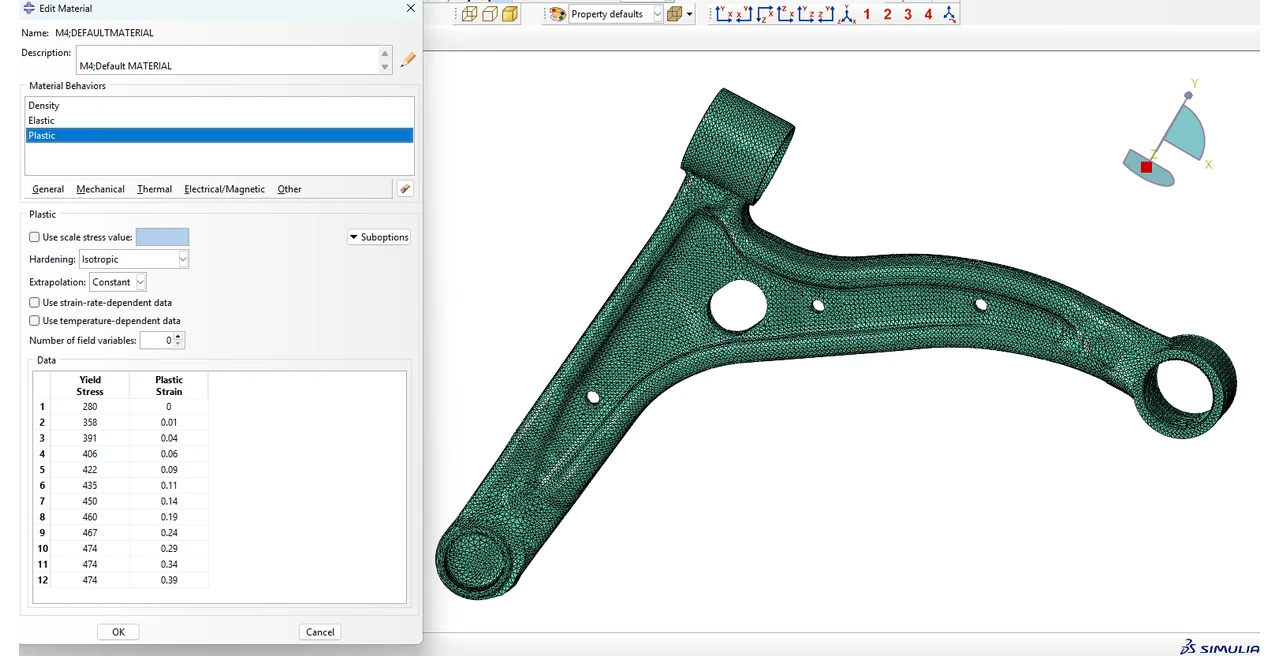
Control arm buckling analysis must include both material and geometric nonlinearity. That combination captures yielding, plastic deformation, large displacement, stiffness degradation and stress redistribution—behaviour a linear elastic model cannot represent. For automotive R&D, it provides a more realistic view of load-bearing capacity and the onset of instability.
Why linear FEA tells only half the story
An automotive control arm carries a demanding combination of tensile, compressive, bending and torsional loads. A linear elastic analysis assumes small deformation and a constant relationship between stress and strain. Once local yielding or large shape changes begin, those assumptions no longer describe the structural response accurately.
Which nonlinearities matter in control arm analysis?
Material nonlinearity
A nonlinear stress–strain curve allows the model to represent yielding, plastic deformation, stiffness degradation and stress redistribution. This is essential when the objective is to understand behaviour beyond the purely elastic range.
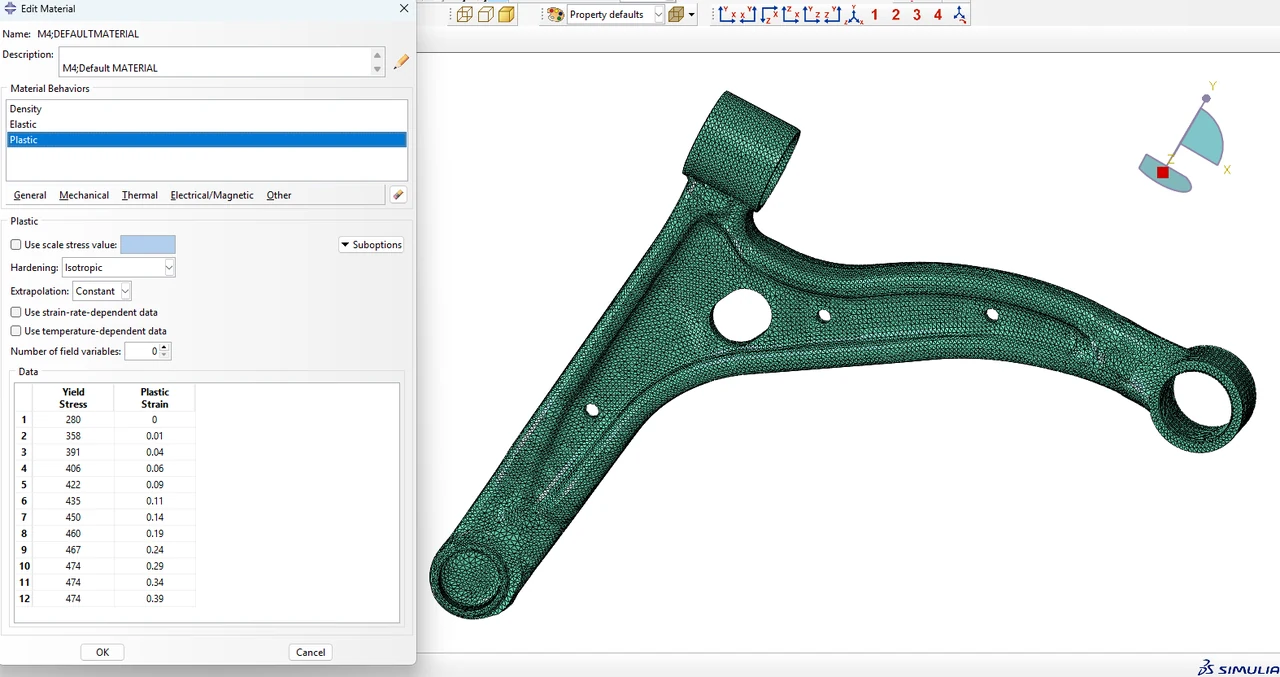
Geometric nonlinearity
Activating geometric nonlinearity accounts for large displacements, large rotations and geometric softening under increasing load. In Abaqus, this behaviour is enabled through the NLGEOM setting in the analysis step.
*STEP, inc=200, amplitude=ramp, nlgeom=YES
*STATIC
0.1,1.0
What does nonlinear FEA reveal?
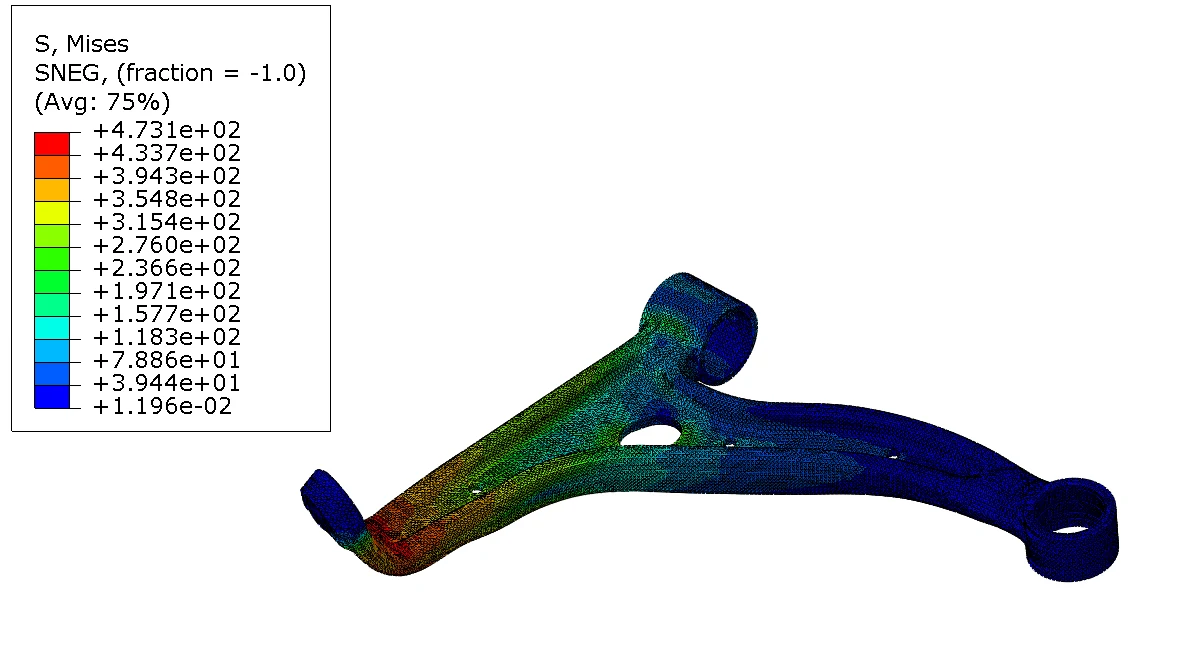
- Stress concentration: high von Mises stress develops around the upper branches and cross-section transitions.
- Stiffness degradation: the overall structural response softens as plasticity and geometry changes develop.
- Instability and post-buckling behaviour: the model shows how load paths and deformation evolve after the response leaves the linear range.
How do the results support automotive R&D?
Nonlinear analysis helps engineering teams move from a simple elastic pass/fail result to a clearer understanding of how the component carries load and where instability begins.
- Estimate realistic load-bearing capacity before physical validation.
- Identify hidden critical zones and investigate collapse behaviour.
- Evaluate lightweighting opportunities without ignoring structural safety.
Frequently asked questions
Why is linear FEA not enough for control arm buckling?
Linear FEA assumes small deformation and elastic material behaviour. It can locate high-stress regions, but it cannot represent yielding, permanent deformation, stiffness loss or changing geometry. A nonlinear model is therefore required when the analysis must follow the component toward instability or post-buckling response.
Which outputs should engineers review together?
Von Mises stress should be reviewed alongside plastic strain, deformation and the change in structural stiffness as load increases. Looking at these outputs together helps distinguish a local stress concentration from a broader loss of load-carrying capability.
Key takeaway
Nonlinear FEA requires more computational effort, but it is the appropriate approach when control arm safety, lightweighting and post-buckling behaviour must be assessed together. Explore Leanos Automotive R&D services or discuss a CAE problem with our engineering team.